
iLegis Travel Log: How the Costa Rican Government preserves natural resources—Conservation lessons from hiking in Costa Rica
By way of introduction, I’m Cathy Pagano, one of our iLegis organizers and a co-chair of our promotions committee. I’m adding this entry to our periodic iLegis travel logs, by sharing impressions from a 10-day hiking trip to Costa Rica in December, 2025. While visiting this amazing country, my spouse and I were impressed to see how the Costa Rican government, aided by its legislature, is helping to conserve the unique natural areas of the country, to preserve precious resources for the future.
We visited many gorgeous natural areas, including Parque Nacional Volcán Rincón de la Vieja, Parque Nacional Volcán Tenorio, Parque Nacional Volcán Arenal, and Parque Nacional Juan Castro Blanco. The Costa Rican people are very gracious. They have an over 90% literacy rate[i], and they kindly tried to understand our efforts to speak Spanish. Their fresh fruit is incredible. Costa Rica also enjoys an incredible diversity and profusion of wildlife and vegetation, so hiking there is like entering a National Geographic video. We saw parades of leaf-cutter ants toting large leaves; countless epiphytes living off trees but doing no harm to them, and strangler fig trees with sculpture-like root systems. I even got bitten by a fire ant, and no damage done, but those creatures would make incredible surgeons!
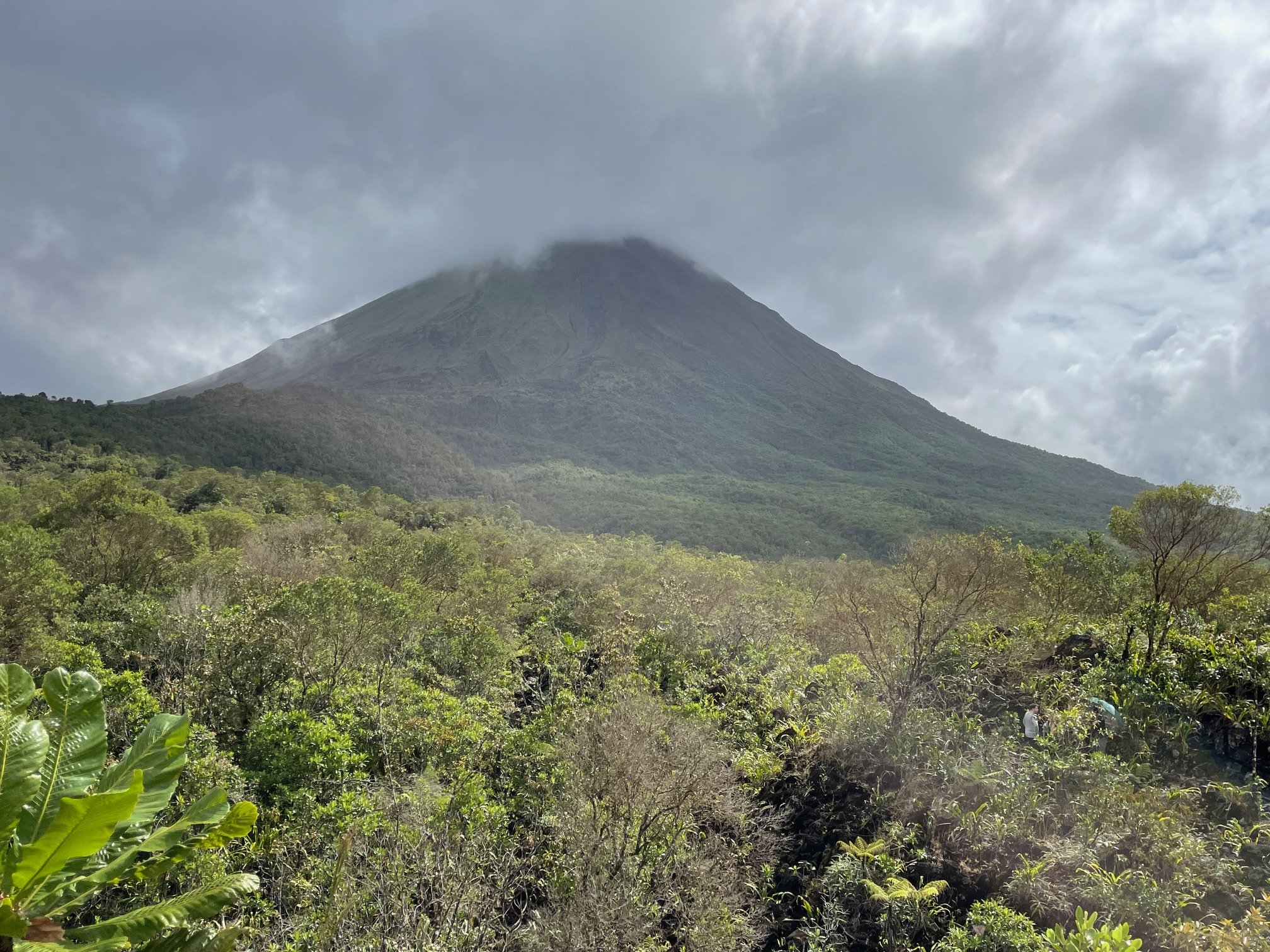
Parque Nacional Volcán Arenal, Costa Rica (Photo by C. Pagano)
About twice the size of the eastern U.S. state of Maryland,[ii] Costa Rica is one of the most biodiverse places in the world,[iii] while sharing this limited territory with about 5.2 million people. Reportedly, about half a million species may live there, or about 5% of the estimated species on Earth.[iv] Situated on the Isthmus of Panama, Costa Rica is a part of the Central American land bridge, a vital connection between South and North America.
Our hiking experience made us wonder how Costa Rica works to enhance and conserve the natural world, helping preserve it for the future. Costa Rica protects around 28 National Parks and conservation areas.[v] With lush rainforests, impressive volcanos, and beaches on the Pacific and the Caribbean, the legislature and government of Costa Rica have reason to protect their natural world. And these efforts are crucially needed. The World Wildlife Fund's Living Planet Report 2024 shares that there has been a catastrophic 73% decline in the average size of monitored wildlife populations in just 50 years (1970-2020).[vi] With only 0.03% of the world's land mass,[vii] small but mighty Costa Rica is fighting this decline with its renowned conservation programs.
Boasting a stable civilian democratic governance since adoption of its new Constitution in 1949.[viii] Costa Rica has a unicameral Legislative Assembly, the Asamblea Legislativa de la República de Costa Rica, located in the capital city of San José.[ix] The 57-member Asamblea is a member of IPU (Inter-Parliamentary Union) Parline, which provides Global Data on national parliaments.[x]
How has the government supported conservation in Costa Rica and what can we learn from its work? It took considerable effort after a conservation wake up call. Before 1940, around 75% of Costa Rica was forested, but by 1987, due to extensive logging, an estimated half of Costa Rica's forest cover had disappeared.[xi] Seeing this dramatic change in such a short time period, the Costa Rican government enacted laws banning deforestation without government approval; moreover, government-initiated programs assisted with ecological services payments, to support Costa Ricans in restoring forests, and as a result, around 60% of the country has returned to forest cover.[xii]
Costa Rica's efforts also include a Strategic Plan published by the Sistema Nacional de Áreas de Conservación (National System of Conservation Areas) for 2023-2030.[xiii] In addition, Costa Rica has ratified several sub-regional conventions, including the Regional Convention for the Management and Conservation of Natural Forest Ecosystems and the Development of Forest Plantations; other legislation includes: Forestry Law Nº 7575, Public Services Regulatory Authority Law, Environment Organic Law, Soil Conservation Law and Biodiversity Law, among others, which together compose the framework to execute the Environmental Service Payment Program.[xiv]
We hiked just a few of the national parks of Costa Rica, and were completely impressed to see firsthand some of the results of Costa Rica’s many conservation efforts. Costa Rica is a model well worth following, an inspiration for others who want to conserve our natural world.
--by Cathy Pagano, iLegis Organizers Committee
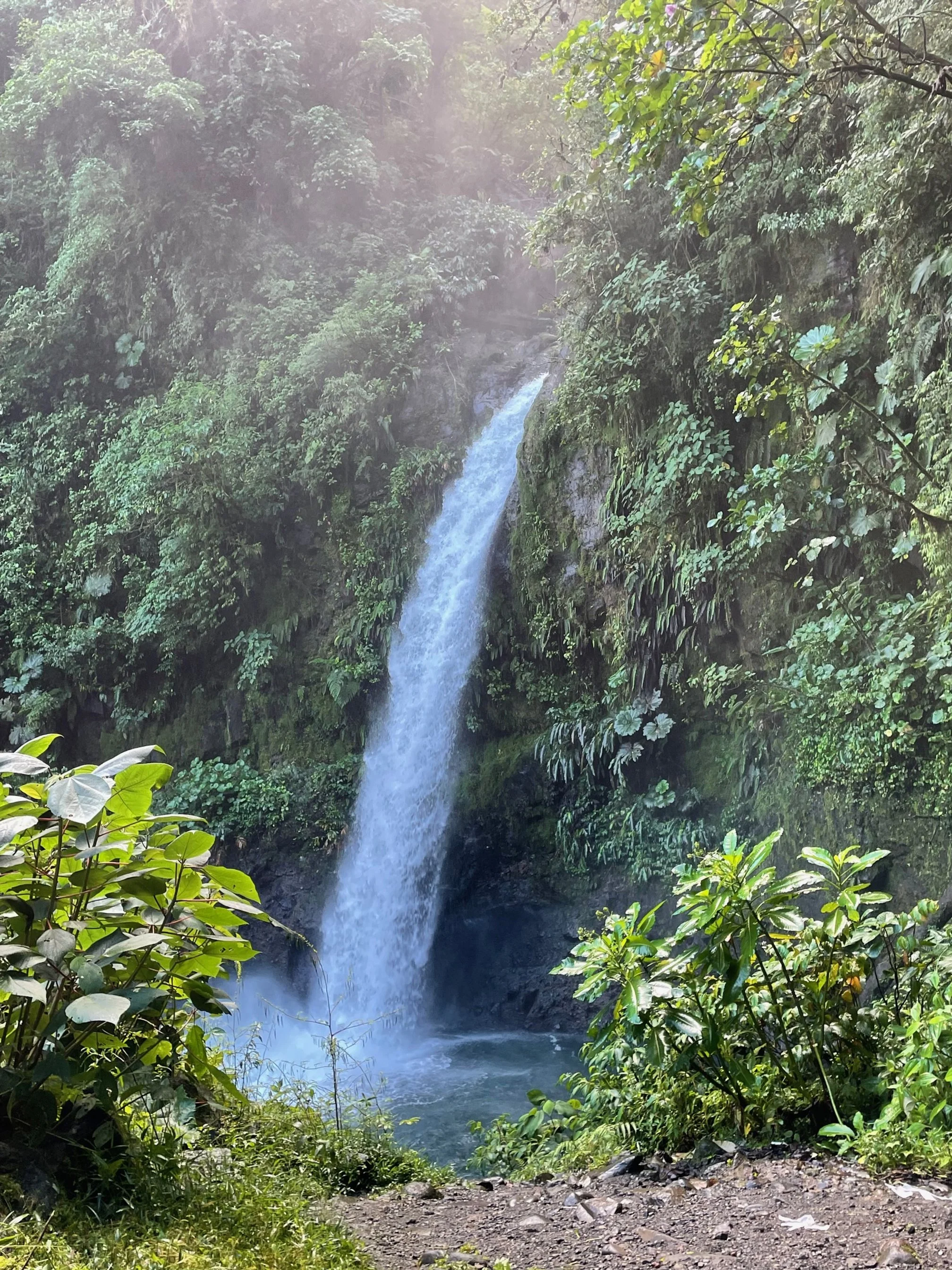
Parque Nacional Volcán Arenal, Costa Rica (Photo by C. Pagano)
[i] “Costa Rica,” Brittanica, accessed January 13, 2026; https://www.britannica.com/place/Costa-Rica.
[ii] Peter J. Meyer, "Costa Rica: An Overview," Congress.gov, Library of Congress, January 13, 2026:https://www.congress.gov/crs-product/IF10908.
[iii] Eddie Johnston, "Costa Rica: Paradise on Earth," Kew Gardens (UK), Feb. 16, 2022: https://www.kew.org/read-and-watch/costa-rica-biodiversity.
[iv] Johnston, “Costa Rica: Paradise on Earth," see above, endnote iii.
[v] “Plan estratégico institucional del SINAC 2023-2030,” Institutional Strategic Plan of the SINAC (Sistema Nacional de Áreas de Conservación), Costa Rica, p. 64: https://www.sinac.go.cr/ES/docu/Planificacion/Plan%20Estrat%C3%A9gico%20Institucional%20SINAC%202023-2030.pdf.
[vi] “Living Planet Report 2024,” World Wildlife Fund (in collaboration with the Zoological Society of London), p. 7, https://www.worldwildlife.org/documents/614/5gc2qerb1v_2024_living_planet_report_a_system_in_peril.pdf.
[vii] Johnston, “Costa Rica: Paradise on Earth,” see above, endnote iii.
[viii] Meyer, “Costa Rica: An Overview," see above, endnote ii.
[ix] Asamblea Legislativa de la República de Costa Rica: https://www.asamblea.go.cr/SitePages/Inicio.aspx; see also above, endnote ii.
[x] IPU (Inter-Parliamentary Union) Parline, Global Data on national parliaments: https://data.ipu.org/parliament/CR/CR-LC01/. See also https://www.ipu.org/.
[xi] Johnston, "Costa Rica: Paradise on Earth," see above, endnote iii.
[xii] Johnston, "Costa Rica: Paradise on Earth," see above, endnote iii.
[xiii] “Plan estratégico institucional del SINAC 2023-2030,” see above, endnote v.
[xiv] “History,” Fondo Nacional de Financiamiento Forestal (Costa Rica's National Forestry Financing Fund), Ministerio de Ambiente y Energía, https://www.fonafifo.go.cr/en/conozcanos/historia/.